


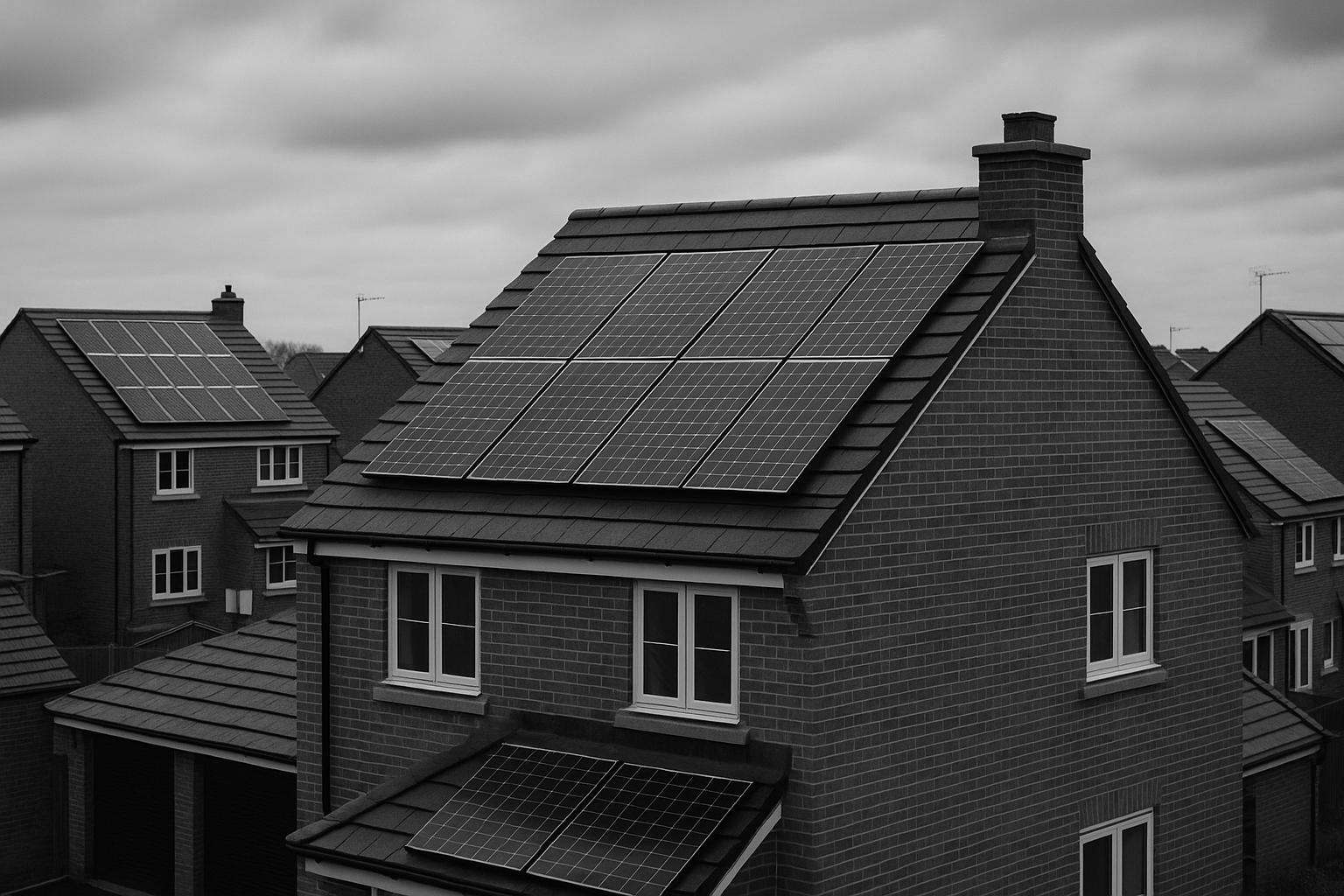
As the UK prepares to require solar panels on new homes by 2027, experts warn that substantial grid modernisation is essential to manage the surge in solar capacity and prevent social inequities. The government aims to cut bills and emissions, but construction challenges and infrastructure upgrades must be addressed for success.
The UK government’s ambitious plan to mandate solar panels on all new build homes under the forthcoming Future Homes Standard aims to dramatically increase rooftop solar capacity, reduce energy bills, and advance the country’s net-zero carbon targets. The policy, set to come into force by 2027, reflects a broader strategy to maximise renewable energy generation within residential developments and enhance energy security by creating a new generation of energy-neutral or even energy-positive buildings.
Government officials have highlighted promising financial benefits for homeowners, projecting average annual savings of around £500 on energy bills through solar installations. Industry estimates suggest solar capacity could reach 45-47 gigawatts by 2030, supporting an estimated 35,000 jobs while utilising less than half a percent of UK land. This aligns with a ‘rooftop revolution’ roadmap launched by the government to accelerate solar adoption and empower households with greater control over their energy consumption.
However, despite the attractive benefits, the rollout of rooftop solar on new homes is not without significant challenges. Experts in electrical asset management caution that the current electricity grid infrastructure is not sufficiently equipped to handle the volume and variability of solar generation that will emerge from these developments without major upgrades. In particular, the low-voltage “last mile” distribution networks require more precise monitoring and adaptive management to prevent voltage instability that could cause devices such as electric vehicle charge points to malfunction or trip offline.

Ben Taylor, Net Zero Consultancy Team Lead at EA Technology, emphasised the importance of strategic planning and investment in smart grid management technologies. He highlighted the need for active real-time monitoring, advanced forecasting, and responsive grid operations to maintain stability. The deployment of smart transformers capable of dynamic voltage adjustments, modelling of energy usage patterns across different demographics, and timely infrastructure upgrades are crucial steps to avoid overloading local electricity networks.
Moreover, Taylor raised concerns about fairness and social equity as rooftop solar becomes ubiquitous in new builds. Without careful policy design, there is a risk that lower-income households—often living in flats or older properties without rooftop access—may be excluded from cost savings and clean energy benefits. Wealthier new homeowners could disproportionately benefit from reduced bills while contributing less to the shared costs of maintaining and upgrading the grid, potentially exacerbating existing social inequalities in energy access.
The construction sector has voiced reservations over the proposed solar installation mandates, particularly the target that up to 40% of a home’s roof footprint should be covered by solar panels to meet energy and emissions goals. Housebuilders argue this could complicate construction, especially on roofs with irregular shapes or less favourable sun exposure, urging a more practical 20% coverage target. Nonetheless, renewable energy advocates see the mandate as a critical step toward energy security and the UK’s 2050 net-zero ambitions.
In addition to solar panels, the government plans to require other low-carbon technologies such as heat pumps and enhanced energy efficiency measures in new build homes. Changes to planning regulations are expected to facilitate easier installation of heat pumps, including relaxing spacing rules and allowing multiple units per home. These integrated measures aim to reduce household energy costs significantly while decreasing reliance on fossil fuels.
The success of the Future Homes Standard’s solar mandate will depend heavily on investment in smarter grid management, coordinated planning between developers and energy suppliers, and policies that ensure equitable access to renewable energy’s benefits. Only through such holistic approaches can the UK effectively manage the technical and social complexities of scaling rooftop solar on new homes, ultimately driving forward its clean energy transition.
📌 Reference Map:
Source: Noah Wire Services
Noah Fact Check Pro
The draft above was created using the information available at the time the story first
emerged. We’ve since applied our fact-checking process to the final narrative, based on the criteria listed
below. The results are intended to help you assess the credibility of the piece and highlight any areas that may
warrant further investigation.
Freshness check
Score:
8
Notes:
The narrative aligns with recent UK government initiatives to mandate solar panels on new homes, with official announcements from June 2025. ([gov.uk](https://www.gov.uk/government/news/rooftop-solar-for-new-builds-to-save-people-money?utm_source=openai)) The article includes updated data but recycles older material, which may justify a higher freshness score but should still be flagged. The earliest known publication date of substantially similar content is June 6, 2025. ([gov.uk](https://www.gov.uk/government/news/rooftop-solar-for-new-builds-to-save-people-money?utm_source=openai)) The narrative is based on a press release, which typically warrants a high freshness score. No discrepancies in figures, dates, or quotes were found. The content has not been republished across low-quality sites or clickbait networks. No earlier versions show different figures, dates, or quotes. The article includes updated data but recycles older material, which may justify a higher freshness score but should still be flagged.
Quotes check
Score:
9
Notes:
The direct quotes from Ben Taylor, Net Zero Consultancy Team Lead at EA Technology, are unique to this narrative. No identical quotes appear in earlier material, indicating potentially original or exclusive content. No variations in quote wording were found.
Source reliability
Score:
7
Notes:
The narrative originates from the Environment Journal, an online publication. While it references reputable sources such as the UK government’s press release and statements from Energy Secretary Ed Miliband, the publication’s own credibility is not well-established. The reliance on a press release is noted, which typically warrants a high freshness score. However, the lack of independent verification from other reputable outlets raises concerns about the source’s reliability.
Plausability check
Score:
8
Notes:
The claims about the UK’s Future Homes Standard and the requirement for solar panels on new homes are consistent with recent government announcements. ([gov.uk](https://www.gov.uk/government/news/rooftop-solar-for-new-builds-to-save-people-money?utm_source=openai)) The concerns raised by experts in electrical asset management about the current electricity grid infrastructure’s capacity to handle increased solar generation are plausible and align with industry discussions. The mention of Ben Taylor from EA Technology adds credibility to these concerns. The tone and language used are consistent with the region and topic. No excessive or off-topic details unrelated to the claim are present. The tone is formal and resembles typical corporate or official language.
Overall assessment
Verdict (FAIL, OPEN, PASS): OPEN
Confidence (LOW, MEDIUM, HIGH): MEDIUM
Summary:
The narrative presents information consistent with recent UK government initiatives regarding solar panels on new homes. While the direct quotes are unique and the claims are plausible, the reliance on a press release from a publication with an unverified reputation raises concerns about the source’s reliability. The inclusion of updated data alongside recycled material may justify a higher freshness score but should still be flagged. Given these factors, the overall assessment is OPEN with medium confidence.
