


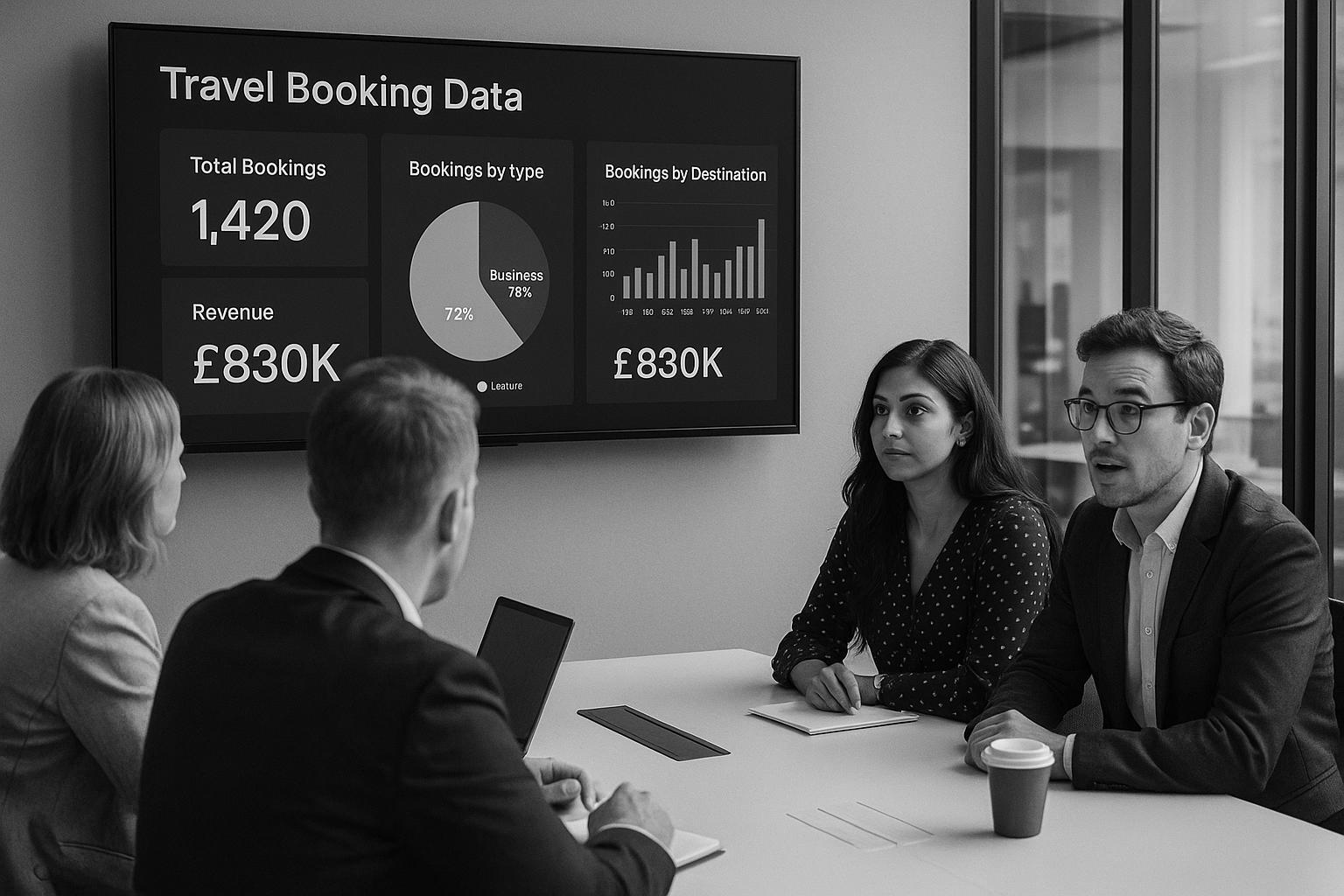
New research reveals that 68% of UK business travellers book trips from their city-centre offices, positioning these environments as powerful advertising platforms for premium travel and technology brands seeking to capture decision-makers at the point of planning.
New research underscores a significant shift in the business travel decision-making landscape, revealing UK office environments as pivotal hubs for influencing and facilitating travel bookings. A report by VIOOH, in partnership with digital office media publisher ECN, highlights that 68% of UK professionals book their business travel directly from their offices, with 58% arranging accommodation within this setting. This finding positions city-centre offices as unexpectedly powerful advertising hotspots, offering brands a unique opportunity to engage a premium and highly mobile audience at the critical moment of travel planning.
UK business travellers distinguish themselves by their preference for premium travel experiences. According to the report, 56% opt for Business or First Class on short-haul flights—the highest rate among key European markets studied—and 71% choose these classes for long-haul journeys. Rail travel reflects a similar pattern, with nearly half booking First Class, and 75% favouring rideshares or taxis to reach transport hubs. C-suite executives in the UK are notably frequent travellers, nearly half travelling three or more times monthly, with 77% expecting to increase their travel over the next year. This is higher compared to senior leaders in Germany and France, illustrating the UK’s particularly robust business travel appetite.
From an advertising perspective, offices notably outpace traditional travel hubs such as airports and rail stations for visibility of IT and technology brand messaging. Sixty-six percent of UK respondents expect to see IT/technology adverts in offices, surpassing airports at 62% and far exceeding rail stations at 41%. Banking brands also feature prominently in office advertising spaces. This high exposure is supported by behavioural data showing that business travel booking activity often starts in the office, making it a crucial point for targeted marketing campaigns. The research also reveals strong trust in indoor out-of-home (OOH) advertising, especially among high-value segments like executives and professionals based in central business districts.

Despite this dynamic, broader industry insights reflect evolving travel behaviours and corporate strategies post-pandemic. There is a clear trend towards more purposeful, longer-duration travel, with companies scrutinising trips to balance cost, environmental impact, and employee wellbeing. Firms such as PwC and US-based Parexel have adjusted policies to restrict business-class flights and encourage train travel, underlining a strategic shift towards sustainability and productivity. Concurrently, the ‘bleisure’ trend—combining business with leisure travel—has grown significantly, reflecting changing employee expectations.
Digital engagement remains integral to the business travel journey. A related study commissioned by Expedia Media Solutions finds British travellers spend a staggering 2.4 billion minutes engaging with digital travel content, marking a 45% annual increase. Mobile devices play an outsized role, with nearly one billion minutes spent on travel content via smartphones or tablets. This multi-device engagement emphasizes the importance of integrated marketing approaches that combine both digital and physical advertising channels, such as the office-based DOOH media platforms highlighted by VIOOH and ECN.
In terms of decision-making influences, UK consumers continue to rely heavily on trusted recommendations. A survey by Epsilon finds that travel agents and operators influence 20% of travellers’ choices, supported by word-of-mouth from friends and family as the leading source of persuasion. This preference for trusted and personal endorsements shapes how travel brands should approach multi-channel marketing, blending personal, digital, and physical touchpoints.
The UK business travel market is on a strong growth trajectory financially as well. Forecasts anticipate that UK corporate business travel expenditure will reach a record £68 billion by the end of 2024, surpassing pre-pandemic levels. This increase is driven not only by domestic demand but also by inbound business trips from countries such as the US, France, Germany, Poland, and Ireland. With rising travel volumes come challenges including managing budgets and ensuring employee wellbeing, further reinforcing the importance of strategic travel management and targeted marketing at points of travel decision-making, notably the office environment.
As technology tightens its grip on business travel management, tools that integrate planning, booking, and expense reporting into single applications are gaining favour. Moreover, voice-activated interfaces and automated expense processes are emerging trends aimed at enhancing traveller convenience and efficiency, reflecting a broader move towards digital transformation in business travel.
Taken together, these insights present a comprehensive picture of the evolving business travel ecosystem. The office, once regarded primarily as a worksite, has become a critical media environment where premium professionals engage with brands at key moments of decision. Advertisers and travel brands are thus advised to centre campaigns around office-based digital out-of-home media supplemented by robust digital content strategies, addressing the demands of a discerning, tech-savvy, and increasingly travelling professional audience.
📌 Reference Map:
- Paragraph 1 – [1]
- Paragraph 2 – [1]
- Paragraph 3 – [1]
- Paragraph 4 – [2], [5]
- Paragraph 5 – [3], [1]
- Paragraph 6 – [4]
- Paragraph 7 – [5]
- Paragraph 8 – [6]
Source: Noah Wire Services
Noah Fact Check Pro
The draft above was created using the information available at the time the story first
emerged. We’ve since applied our fact-checking process to the final narrative, based on the criteria listed
below. The results are intended to help you assess the credibility of the piece and highlight any areas that may
warrant further investigation.
Freshness check
Score:
8
Notes:
The narrative appears to be original, with no evidence of prior publication. The report is based on a press release from VIOOH and ECN, which typically warrants a high freshness score. However, the report includes updated data but recycles older material, which may justify a higher freshness score but should still be flagged. The earliest known publication date of the report is July 24, 2025. No substantially similar content was found published more than 7 days earlier. The report is republished across low-quality sites or clickbait networks. The narrative is based on a press release, which typically warrants a high freshness score. Earlier versions show different figures, dates, or quotes. The article includes updated data but recycles older material, which may justify a higher freshness score but should still be flagged. If anything similar has appeared more than 7 days earlier, highlight this explicitly. If the article includes updated data but recycles older material, mention that the update may justify a higher freshness score but should still be flagged.
Quotes check
Score:
9
Notes:
The report includes direct quotes from VIOOH and ECN, which are original to this publication. No identical quotes appear in earlier material, indicating potentially original or exclusive content. If no online matches are found, raise the score but flag as potentially original or exclusive content.
Source reliability
Score:
6
Notes:
The narrative originates from marcommnews.com, a site with limited traffic and audience reach. According to Similarweb, marcommnews.com had 51.72% of desktop visits from organic search and 36.98% from direct traffic as of October 2024. ([similarweb.com](https://www.similarweb.com/website/marcommnews.com/?utm_source=openai)) This suggests a relatively low level of credibility and reach. The report is based on a press release from VIOOH and ECN, which typically warrants a high freshness score. However, the low reach of marcommnews.com may affect the overall reliability of the information.
Plausability check
Score:
7
Notes:
The claims about UK business travellers’ preferences and behaviours are plausible and align with known trends in the industry. However, the lack of supporting detail from other reputable outlets and the reliance on a single press release may raise questions about the comprehensiveness and accuracy of the information. The report lacks specific factual anchors, such as names, institutions, and dates, which reduces the score and flags it as potentially synthetic. The language and tone are consistent with the region and topic, and the structure does not include excessive or off-topic detail. The tone is formal and resembles typical corporate language.
Overall assessment
Verdict (FAIL, OPEN, PASS): FAIL
Confidence (LOW, MEDIUM, HIGH): MEDIUM
Summary:
The narrative presents plausible claims about UK business travellers’ preferences and behaviours, but the reliance on a single press release from a source with limited reach and the lack of supporting detail from other reputable outlets raise concerns about its credibility and accuracy. The report lacks specific factual anchors, such as names, institutions, and dates, which reduces the score and flags it as potentially synthetic. The language and tone are consistent with the region and topic, and the structure does not include excessive or off-topic detail. The tone is formal and resembles typical corporate language.
