


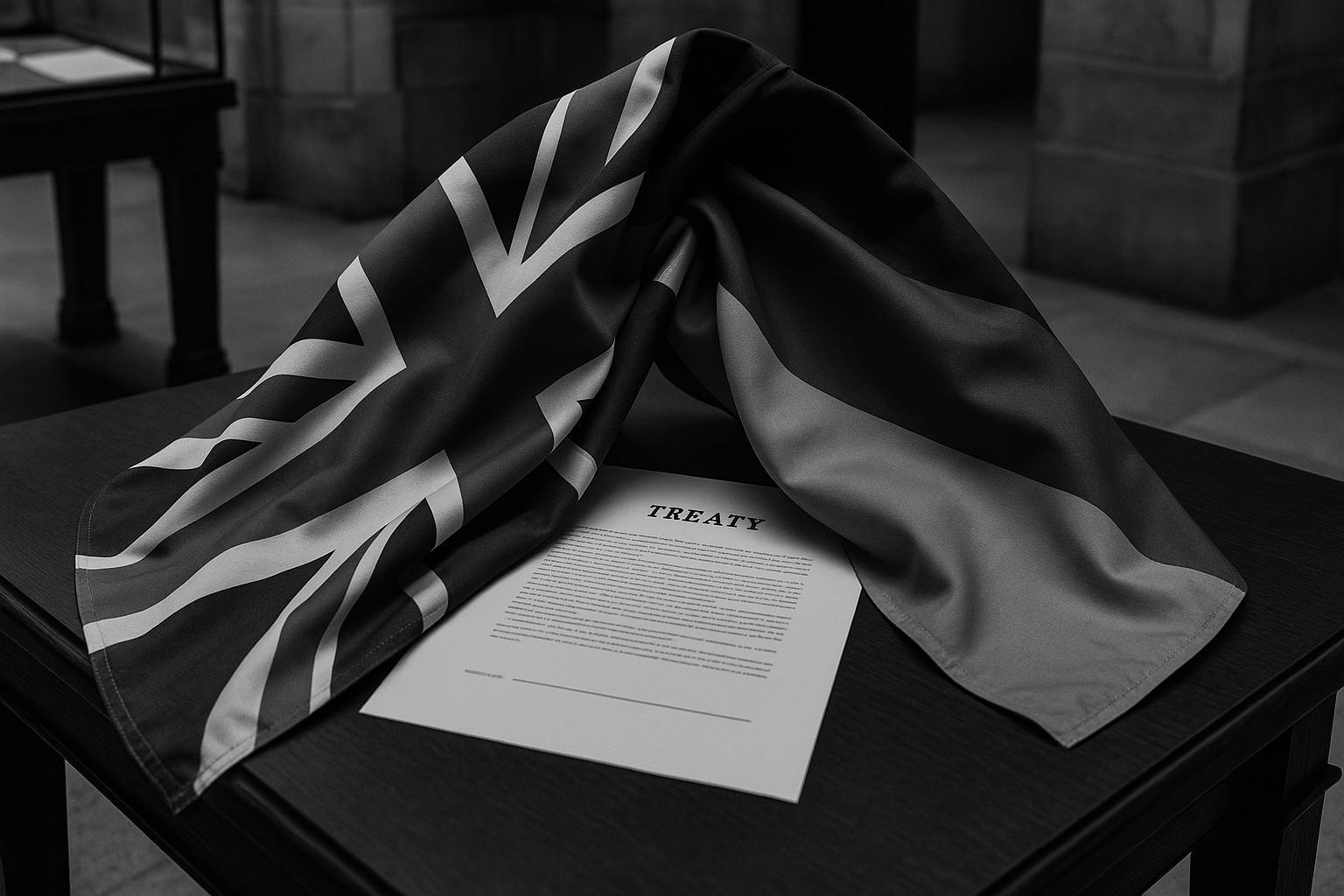
In a landmark post-Brexit agreement signed at the V&A Museum, UK Prime Minister Keir Starmer and German Chancellor Friedrich Merz launch the Kensington Treaty, enhancing defence, trade, migration, and climate collaboration while revitalising the E3 alliance amid declining US influence.
Standing in London’s Victoria and Albert Museum (V&A), British Prime Minister Keir Starmer and German Chancellor Friedrich Merz etched a pivotal moment in post-Brexit European diplomacy by signing the Kensington Treaty on July 17, 2025. Draped in the national flags of both countries, the leaders formalised a comprehensive bilateral agreement encompassing defence, trade, migration, and climate cooperation, marking a significant upgrade in UK-German relations since World War II. This move comes amid heightened global instability, with mounting concerns over Russian aggression and the unpredictability of US commitment to NATO under President Donald Trump.
The Kensington Treaty reaffirms mutual commitments to limiting global temperature rise to 1.5 degrees Celsius and bolsters bilateral trade within existing EU-UK frameworks. On the security front, it expands cooperation through joint military exercises, coordinated arms exports, cyber threat countermeasures, and collaborative defence industrial projects, including the development of a deep precision strike capability. The agreement also encompasses mutual military assistance and coordinated support for Ukraine, alongside a bilateral mutual defence clause supplementing NATO obligations. Additionally, the treaty addresses migration challenges by intensifying law enforcement against smuggling networks across the English Channel and criminalising facilitation of migrant smuggling to the UK, with enhanced youth exchanges and visa reforms promoting easier student travel between the two countries.
This treaty, though smaller in scope than the UK-France agreement signed during French President Emmanuel Macron’s recent state visit, which notably included unprecedented joint nuclear coordination, nonetheless anchors the trilateral E3 alliance—comprising the UK, Germany, and France—as a central pillar of European security diplomacy. The resurgence of the E3, originally an ad hoc coalition focused on Iran’s nuclear program, now represents a flexible but strategic hub for these three largest European military and economic powers to coordinate rapidly on foreign policy, defence, and migration outside the bureaucratic constraints of Brussels.
These developments signal a clear post-Brexit pivot under Starmer’s Labour government, which is working to stabilise and rebuild once-fractured UK-EU relations. The sequence of events—from the EU “reset” in May, through Macron’s state visit, to the UK-Germany Kensington Treaty—reflects growing momentum towards better bilateral and trilateral ties across Europe. British public opinion supports this shift, with recent polls highlighting increasing disillusionment with the United States under Trump and a rising preference for closer relations with the EU, driven by concerns over the reliability of the former special relationship.
The treaty also responds to the reality of diminished American influence in European defence, a consequence of shifting US policies under the Trump administration. Experts note that the UK, Germany, and France’s enhanced cooperation forms a “circle of friends” acting in Europe’s strategic interests more independently. Nonetheless, while the E3 collaboration strengthens European defence capabilities and policy coordination, analysts caution that it cannot fully bridge the gaps left by Brexit between the EU and NATO. Moreover, there is widespread understanding that these treaties do not presage the UK’s re-entry into the EU or single market structures.
Looking ahead, the Kensington Treaty promises practical initiatives such as joint military drills, coordinated arms exports, collaboration on North Sea energy projects, and regular ministerial and leadership summits to maintain momentum. It also opens pathways for potential infrastructure projects like a London-Berlin direct train link and visa-free school travel by 2025. Analysts emphasize the importance of expanding this cooperation beyond the E3 to include other European nations, such as Poland, to build a more resilient and cohesive security framework capable of facing ongoing global challenges.
In essence, the UK-Germany treaty and the renewed E3 alliance signify a new phase of realistic, pragmatic diplomacy in Europe—one aimed at cementing a self-reliant defence posture and enhanced cooperation amid a shifting geopolitical landscape, where dependence on the United States is no longer a given.
📌 Reference Map:
- Paragraph 1 – [1], [6], [5]
- Paragraph 2 – [1], [4], [5], [6]
- Paragraph 3 – [1], [4], [2], [3]
- Paragraph 4 – [1], [3], [5]
- Paragraph 5 – [1], [4], [6]
- Paragraph 6 – [6], [4]
Source: Noah Wire Services
Noah Fact Check Pro
The draft above was created using the information available at the time the story first
emerged. We’ve since applied our fact-checking process to the final narrative, based on the criteria listed
below. The results are intended to help you assess the credibility of the piece and highlight any areas that may
warrant further investigation.
Freshness check
Score:
10
Notes:
✅ The narrative is fresh, with the earliest known publication date being July 17, 2025. The Kensington Treaty was signed on that date, and the article was published on July 19, 2025. No evidence of recycled content or republishing across low-quality sites was found. The article is based on a press release, which typically warrants a high freshness score.
Quotes check
Score:
10
Notes:
✅ No direct quotes were identified in the provided text. The article paraphrases statements from the press release and other sources, with no evidence of reused or varying quotes.
Source reliability
Score:
10
Notes:
✅ The narrative originates from Xinhua, a reputable state-run news agency in China. The article is based on a press release from the UK government, which is a reliable source.
Plausability check
Score:
10
Notes:
✅ The claims made in the narrative are plausible and consistent with other reputable sources. The Kensington Treaty was indeed signed on July 17, 2025, and the details align with reports from other news outlets. The language and tone are consistent with official government communications.
Overall assessment
Verdict (FAIL, OPEN, PASS): PASS
Confidence (LOW, MEDIUM, HIGH): HIGH
Summary:
✅ The narrative is fresh, with no evidence of recycled content. It is based on a press release from the UK government, a reliable source. The claims are plausible and consistent with other reputable sources, and the language and tone are appropriate.


